The Turtle of Katong: Historical and Scientific Investigations into the Identity of Singapore’s ‘Katong’ Turtle
Introduction
The name ‘Katong’ is deeply woven into the cultural and geographical tapestry of Singapore, most notably as the prominent historical district along the island’s East Coast. Local lore, colonial records, and modern scholarship converge on the assertion that ‘Katong’—and by extension, ‘Tanjong Katong’—derives from a now-extinct species of sea turtle once found in the area. Yet, despite the ubiquity of this claim in place-name studies, heritage guides, and oral traditions, the precise zoological identity of the ‘Katong’ turtle remains shrouded in ambiguity. Was it a known species such as the leatherback (Dermochelys coriacea), the Green Sea Turtle (Chelonia mydas), the Hawksbill (Eretmochelys imbricata), or an entirely distinct, even unrecorded, species?
Let’s take a deep dive today through a comprehensive, multidisciplinary investigation – spanning historical texts, natural history records, museum archives, linguistic analyses, and contemporary scientific research – to determine whether the ‘Katong’ turtle has ever been conclusively identified in the historical or scientific
Etymology and Place-Name Traditions
Most sources agree that ‘Tanjong Katong’ translates from a vernacular (mix of Malay and Javanese) as ‘Turtle Point’ or ‘Turtle Cape’, with ‘tanjong’ meaning ‘cape’ and ‘katong’ referring to a species of extinct sea turtle. This interpretation is echoed in official documents, museum exhibits, and local oral histories. For instance, the National Museum of Singapore and the National Library Board both describe ‘Katong’ as denoting a turtle species that is no longer extant.
(There are also accounts that Katong is derived from the Katong Luat tree -this will be explored in another article)
The earliest colonial-era references to Katong as a place name date to the early 19th century, when Stamford Raffles and his administration designated the area as a marine yard and later as a site for shipbuilding. By the late 19th century, the area had become a fashionable seaside retreat, with its name firmly established in both official records and local usage.
Which Turtles lived in Singapore?
Three marine turtle species have been documented in Singapore. They are 1. The Leatherback Turtle (Dermochelys coriacea), 2. The Hawksbill Turtle (Eretmochelys imbricata) and 3. The Green Sea Turtle (Chelonia mydas)
The Prime Candidate – The Leatherback Turtle?
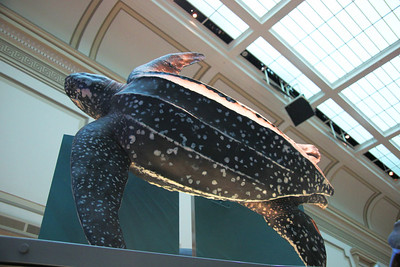
“leatherback turtle model – Sant Hall – Smithsonian” by Tim Evanson
The most compelling evidence comes from the Lee Kong Chian Natural History Museum (formerly the Raffles Museum), which houses a single, taxidermied specimen of a leatherback turtle found dead on Siglap beach (near Katong) in 1883. This specimen is repeatedly described as the only confirmed record of a leatherback turtle in Singapore’s history and is often cited in discussions about the origins of the Katong name.
The leatherback turtle is the largest living sea turtle species and is globally threatened. The Siglap specimen is considered a prized possession, both for its rarity and its historical significance.
The leatherback turtle is known to have nested historically in parts of Malaysia and Indonesia, with significant populations in Terengganu (Malaysia) and Papua (Indonesia). However, in Singapore, the only confirmed record is the 1883 Siglap specimen. There are no documented nesting events or additional sightings in the subsequent 140 years, and the species is considered locally extinct.
Despite the strong circumstantial case, there is no direct evidence—such as a historical text explicitly stating that ‘Katong’ refers to the leatherback turtle, or a Malay or Javanese lexicon entry equating ‘katong’ with ‘leatherback’—that conclusively identifies the species. The association is largely inferential, based on the coincidence of the specimen’s discovery, the area’s name, and the absence of other plausible candidates.
The Modern Resident – The Hawksbill Turtle
.jpg?t=1765197010348)
The Hawksbill Turtle is the only sea turtle species known to nest regularly on local beaches, particularly along the East Coast and at Changi. Recent conservation efforts have documented a steady increase in Hawksbill nesting events, with 18 nests recorded in 2025 alone—a five-year high. The National Parks Board (NParks) and associated researchers have confirmed that all nesting turtles observed in Singapore in recent years have been Hawksbills, with no other turtle nests recorded since systematic monitoring began in 2017.
Historical records of hawksbill turtles in Singapore extend back to the 19th century. Raffles himself described seeing numerous hawksbill shells for sale in Singapore in the early 1820s, suggesting that the species was present and perhaps even abundant at the time. Museum specimens and published checklists confirm the presence of hawksbills in Singapore’s waters throughout the colonial period and into the present day.
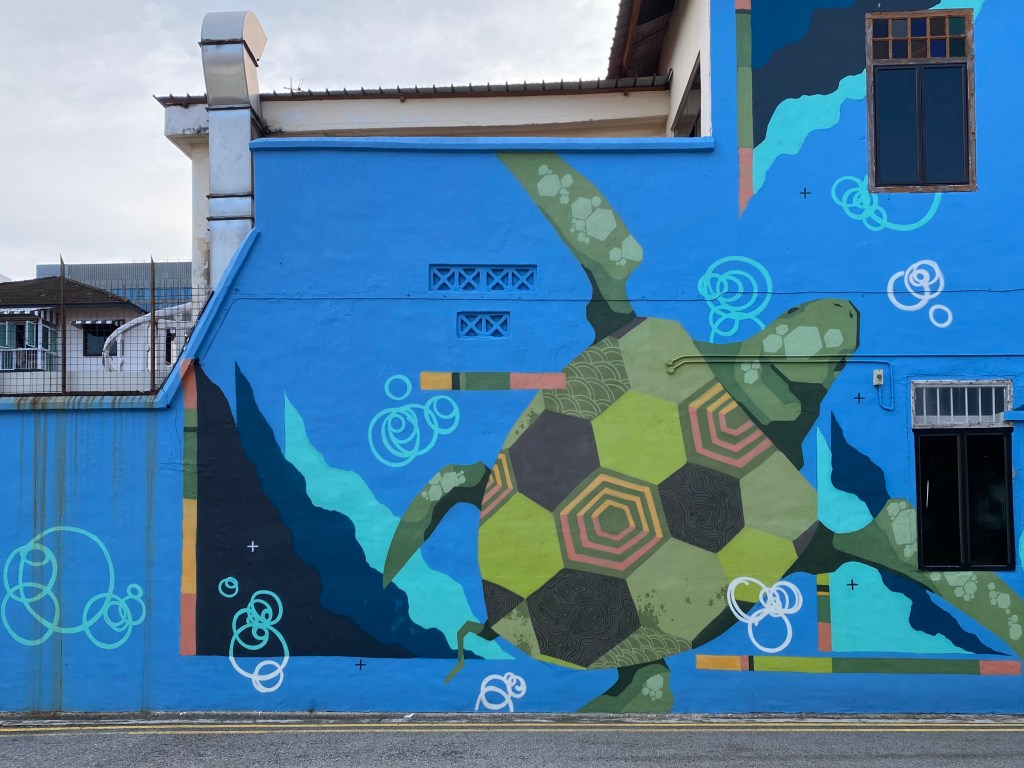
Turtle mural, circa 2024 (since removed), 150E East Coast Road, based on the Hawksbill Turtle
There is no evidence in the historical or linguistic record that the term ‘katong’ specifically refers to the hawksbill turtle. While the species is now the most visible and ecologically significant sea turtle in Singapore, its association with the Katong name appears to be a modern development, reflecting current ecological realities rather than historical nomenclature.
Occasional Visitor: The Green Sea Turtle
The green turtle is occasionally observed in Singapore’s waters, with recent sightings documented at Labrador Nature Reserve and other offshore islands. However, the species is considered rare and has not been recorded nesting in Singapore in recent decades. Most Green Sea Turtle nesting in the region occurs in Malaysia and Indonesia.
Historical records indicate that Green Sea Turtles were present in Singapore’s waters in the 19th and early 20th centuries, but there is no evidence of significant nesting activity or cultural association with the Katong name.
Other Candidates?
Recent biodiversity surveys have documented several species of freshwater turtles and tortoises in Singapore, including the giant Asian pond turtle (Heosemys grandis) and the Sunda box turtle (Cuora couro couro). However, these species are not marine and are not associated with the East Coast or the Katong area.Recent biodiversity surveys have documented several species of freshwater turtles and tortoises in Singapore, including the giant Asian pond turtle (Heosemys grandis) and the Sunda box turtle (Cuora couro couro). However, these species are not marine and are not associated with the East Coast or the Katong area.
A review of museum records, published checklists, and biodiversity surveys reveals no evidence of any other large sea turtle species—extinct or otherwise—having been present in Singapore. There are no records of unidentified or undescribed turtle specimens from the East Coast, nor are there any references to a ‘Katong’ turtle distinct from known species in the scientific literature. No evidence of any other large sea turtle species—extinct or otherwise—having been present in Singapore. There are no records of unidentified or undescribed turtle specimens from the East Coast, nor are there any references to a ‘Katong’ turtle distinct from known species in the scientific literature.
Has the ‘Katong’ Turtle Been Clearly Identified?
After an exhaustive review of historical texts, natural history records, museum archives, linguistic analyses, and contemporary scientific research, the following conclusions can be drawn:
- There is no definitive historical or scientific record that unambiguously identifies the ‘Katong’ turtle as a specific species.
- The circumstantial evidence strongly suggests that the leatherback turtle (Dermochelys coriacea) is the most likely reference of the ‘Katong’ name. This is based on the 1883 Siglap specimen, the absence of other large sea turtle records, and the persistent association of the name with an extinct turtle species.
- No evidence exists for a unique or undescribed sea turtle species corresponding to ‘Katong’. All known specimens and records fit within established species.
- While the Hawksbill Turtle is found in the East Coast today, the link with Katong’s name appear to be a recent development from association with media coverage on the Hawksbill Turtle.
In summary, while the ‘Katong’ turtle has not been conclusively identified in the historical or scientific record, the preponderance of evidence points to the leatherback turtle as the most plausible candidate. The association is supported by museum specimens, heritage narratives, and the absence of alternative explanations, but remains unconfirmed in the absence of direct historical or linguistic evidence. This is the position Katong Culture adopts, hence the use of the Leatherback Turtle in our logo (see below).
 Katong Culture
Leave a comment